TVET Sector Support Program 2026
Pakistan Technical & Vocational Education & Training Reforms
The TVET Sector Support Program encompasses initiatives designed to improve Technical and Vocational Education and Training systems globally. These programs often focus on curriculum development, teacher training, infrastructure improvement, and industry partnerships to better align TVET with labor market needs. In Pakistan, people find jobs based on their interests every year.
Many people are involved in various job fields without any prior knowledge about them. Here we provide you with the complete information about which TVET Courses are offered and how you can apply. The TVET stands for (Pakistan Technical & Vocational Education & Training Reforms) mission, as defined by the Ministry of Education (MoE), is to provide trained and skilled manpower as required by the Pakistani labor market.
Amidst Pakistan’s ambitious goals for economic growth and development, the TVET Sector Support Program emerges as a cornerstone strategy, dedicated to empowering individuals with practical skills and competencies essential for driving innovation, productivity, and prosperity across diverse industries. In Pakistan’s pursuit of economic resilience and social equity, the TVET Sector Support Program emerges as a beacon of hope, driving forward an agenda of empowerment, inclusion, and excellence in technical and vocational education, poised to shape a brighter future for generations to come.
The TVET Sector Support Program trained the young generation to participate in private institutes or for their employment. All the students complete their TVET program and can get a job related to their course. On an annual basis, 1.8 million people enter the job profession. But in 2018, the number of job-offering institutes is 433,237 formal Technical and Vocational Education and Training (TVET)1, and in Pakistan, 3,740 were available.
Stages of TVET Sector Support Program
In December 2016, the first stage started, which was designed based on the National Skills Strategy. During this period, the turning point of this program has arrived at the National TVET Policy, the National Vocational Qualifications Framework (NVQF), and the introduction of Competency Based Training & Assessment (CBT&A), etc.
In 2022, the second stage of this program was announced. The main objective of this stage to help the Government and private sectors for Pakistani youth and all those people return to their country after getting an education or doing some other tasks. This program helps to support labor in the market.
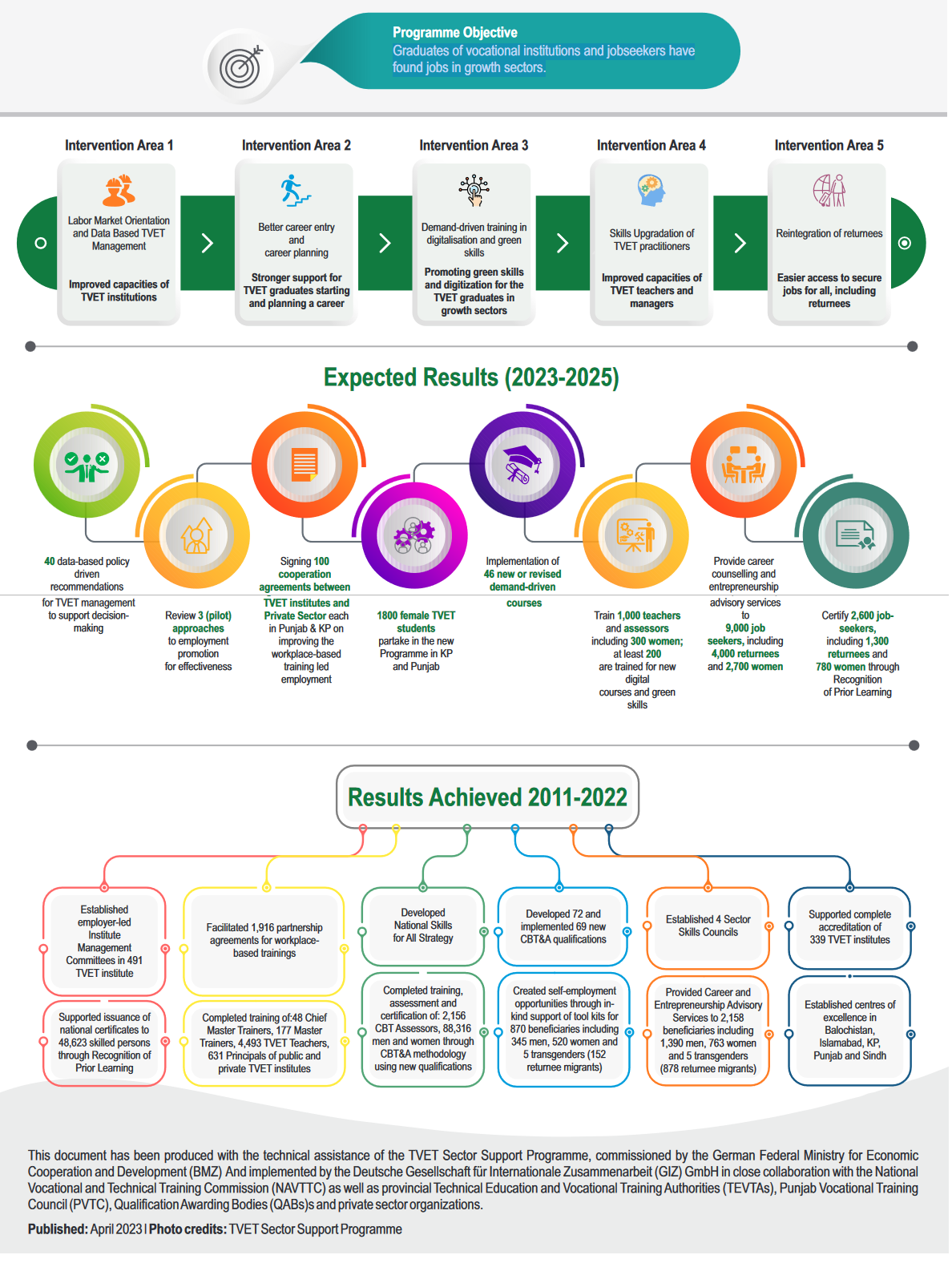
The third stage of this program is to benefit the Federal Republic of Germany, depending on the strategy, with the main purpose of “Graduates of vocational institutions and jobseekers have found jobs in growth sectors”. This program also depends on Green skills, such as digitization and gender, as core themes.
With the help of this program, more than 70% of women find jobs with the cooperation of Career Counselling and Job Placement Career Counseling and Job Placement (CCJP) centers.
After completing this program, the institute guarantees that people will receive 3,600 to 6,000 opportunities that help to find employment. In this opportunity, 1,080 women and 2,880 young people were included. On the side of this, 1,000 of 2,000 Graduates of skill-based short courses are available for employees or the self-employed. In this section, at least 300 women. In 2011, the Government of Pakistan was bolstered with the help of the European Union. The Governments of Germany, the Netherlands, and Norway.
TVET Institutions
Public TVET Institutions
- Govt. Staff Training College (TEVTA Punjab) (TEVTA)
- National Institute of Science and Technical Education (NISTE)
- National Productivity Organization (NPO)
- National Training Bureau (NTB)
- National Vocational and Technical Education Commission (NAVTTC)
- Punjab Vocational Training Council (PVTC)
- TEVTA – AJK
- TEVTA – Balochistan
- TEVTA – KPK
- TEVTA – Punjab
- TEVTA – Sindh
FAQs
Q1: What exactly is the TVET Sector Support Programme?
It is a government-EU/Germany co-funded project to modernize Pakistan’s technical and vocational training system, making it more effective, relevant, and inclusive.
Q2: Who provides this programme?
It is implemented by institutions such as NAVTTC, GIZ, British Council, and funded by the European Union and the Federal Republic of Germany.
Q3: Can rural youth or women apply?
Yes. The programme has provisions to include and benefit women, minorities, and rural/underserved areas.
Q4: What kind of skills will I learn?
Skills in demand-driven trades, including digital technology, green skills, modern tools, and possibly traditional trades upgraded with modern methods.
Q5: Will I get certified training?
Yes. Most training is under-recognized institutes, aligned with national qualifications frameworks, so certificates are expected.